
Characterization Methods#
A Characterization Method is a standardized approach for calculating environmental impacts from elementary flows.
Each method is a published set of conversion factors. Applying one means multiplying every elementary flow inside your System Boundary by its factor for a category, then summing. That total is your result.
Methods are maintained by standards bodies and research institutions. Circa applies the published factors rather than setting its own.
Types of Characterization Methods#
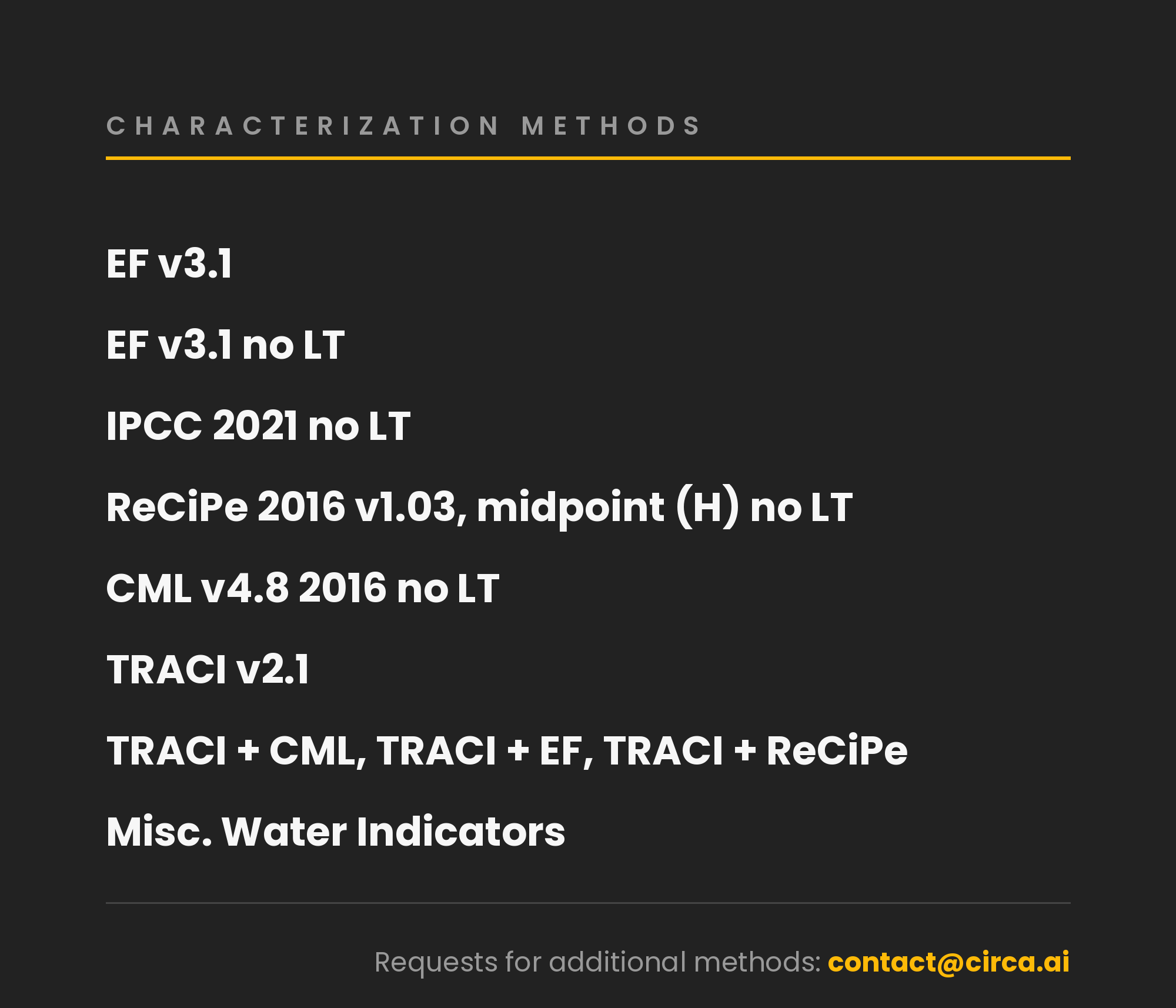
Circa currently offers 6 Characterization Methods: EF 3.1, ReCiPe 2016, CML-IA, TRACI 2.1, IPCC 2021 and EN 15804+A2.
How Impacts are Stored#
Circa serves the impacts of a Process using one of two approaches. Both produce LCIA results that can be combined within the same System Boundary, but they differ in what is stored and how the result is produced.
Flow-Based Processes#
A Flow-Based Process stores an explicit inventory of elementary flows—emissions released to air, water, or soil and resources extracted from the environment. Gesserit calculates impacts from these flows when you select a Characterization Method.
For every elementary flow inside the System Boundary, Gesserit:
- Normalizes the flow quantity to the selected Reference Point.
- Matches the flow, including its compartment and subcompartment, to the appropriate Characterization Factor.
- Multiplies the normalized quantity by that factor.
- Sums the results for each impact indicator.
Impact-Ready Processes#
An Impact-Ready Process stores pre-calculated LCIA results directly—for example, a climate-change result in kg CO2 eq. Gesserit scales and adds these stored results to the other impacts in the System Boundary instead of recalculating them from elementary flows.
Impact-Ready Processes are fast and compact, making them useful for upstream systems that would otherwise contain thousands of elementary exchanges. Their results also remain consistent with the method used by the dataset publisher. The tradeoff is that they are limited to the methods and indicators included with the dataset, and the underlying flow-by-flow inventory may not be available for inspection or characterization with another method.
Indicators#
CML v4.8 2016 no LT
| Category | Indicator | Unit |
|---|---|---|
| acidification no LT | acidification (incl. fate, average Europe total, A&B) no LT | kg SO2 eq |
| climate change no LT | global warming potential (GWP100) no LT | kg CO2 eq |
| ecotoxicity: freshwater no LT | freshwater aquatic ecotoxicity (FAETP inf) no LT | kg 1,4-DCB eq |
| ecotoxicity: marine no LT | marine aquatic ecotoxicity (MAETP inf) no LT | kg 1,4-DCB eq |
| ecotoxicity: terrestrial no LT | terrestrial ecotoxicity (TETP inf) no LT | kg 1,4-DCB eq |
| energy resources: non-renewable no LT | abiotic depletion potential (ADP): fossil fuels no LT | MJ |
| eutrophication no LT | eutrophication (fate not incl.) no LT | kg PO4 eq |
| human toxicity no LT | human toxicity (HTP inf) no LT | kg 1,4-DCB eq |
| material resources: metals/minerals no LT | abiotic depletion potential (ADP): elements (ultimate reserves) no LT | kg Sb eq |
| ozone depletion no LT | ozone layer depletion (ODP steady state) no LT | kg CFC-11 eq |
| photochemical oxidant formation no LT | photochemical oxidation (high NOx) no LT | kg ethylene eq |
EF v3.1
| Category | Indicator | Unit |
|---|---|---|
| acidification | accumulated exceedance (AE) | mol H+-Eq |
| climate change | global warming potential (GWP100) | kg CO2-Eq |
| climate change: biogenic | global warming potential (GWP100) | kg CO2-Eq |
| climate change: fossil | global warming potential (GWP100) | kg CO2-Eq |
| climate change: land use and land use change | global warming potential (GWP100) | kg CO2-Eq |
| ecotoxicity: freshwater | comparative toxic unit for ecosystems (CTUe) | CTUe |
| ecotoxicity: freshwater, inorganics | comparative toxic unit for ecosystems (CTUe) | CTUe |
| ecotoxicity: freshwater, organics | comparative toxic unit for ecosystems (CTUe) | CTUe |
| energy resources: non-renewable | abiotic depletion potential (ADP): fossil fuels | MJ, net calorific value |
| eutrophication: freshwater | fraction of nutrients reaching freshwater end compartment (P) | kg P-Eq |
| eutrophication: marine | fraction of nutrients reaching marine end compartment (N) | kg N-Eq |
| eutrophication: terrestrial | accumulated exceedance (AE) | mol N-Eq |
| human toxicity: carcinogenic | comparative toxic unit for human (CTUh) | CTUh |
| human toxicity: carcinogenic, inorganics | comparative toxic unit for human (CTUh) | CTUh |
| human toxicity: carcinogenic, organics | comparative toxic unit for human (CTUh) | CTUh |
| human toxicity: non-carcinogenic | comparative toxic unit for human (CTUh) | CTUh |
| human toxicity: non-carcinogenic, inorganics | comparative toxic unit for human (CTUh) | CTUh |
| human toxicity: non-carcinogenic, organics | comparative toxic unit for human (CTUh) | CTUh |
| ionising radiation: human health | human exposure efficiency relative to u235 | kBq U235-Eq |
| land use | soil quality index | dimensionless |
| material resources: metals/minerals | abiotic depletion potential (ADP): elements (ultimate reserves) | kg Sb-Eq |
| ozone depletion | ozone depletion potential (ODP) | kg CFC-11-Eq |
| particulate matter formation | impact on human health | disease incidence |
| photochemical oxidant formation: human health | tropospheric ozone concentration increase | kg NMVOC-Eq |
| water use | user deprivation potential (deprivation-weighted water consumption) | m3 world Eq deprived |
EF v3.1 no LT
| Category | Indicator | Unit |
|---|---|---|
| acidification no LT | accumulated exceedance (AE) no LT | mol H+ eq |
| climate change no LT | global warming potential (GWP100) no LT | kg CO2 eq |
| climate change: biogenic no LT | global warming potential (GWP100) no LT | kg CO2 eq |
| climate change: fossil no LT | global warming potential (GWP100) no LT | kg CO2 eq |
| climate change: land use and land use change no LT | global warming potential (GWP100) no LT | kg CO2 eq |
| ecotoxicity: freshwater no LT | comparative toxic unit for ecosystems (CTUe) no LT | CTUe |
| ecotoxicity: freshwater, inorganics no LT | comparative toxic unit for ecosystems (CTUe) no LT | CTUe |
| ecotoxicity: freshwater, organics no LT | comparative toxic unit for ecosystems (CTUe) no LT | CTUe |
| energy resources: non-renewable no LT | abiotic depletion potential (ADP): fossil fuels no LT | MJ |
| eutrophication: freshwater no LT | fraction of nutrients reaching freshwater end compartment (P) no LT | kg P eq |
| eutrophication: marine no LT | fraction of nutrients reaching marine end compartment (N) no LT | kg N eq |
| eutrophication: terrestrial no LT | accumulated exceedance (AE) no LT | mol N eq |
| human toxicity: carcinogenic no LT | comparative toxic unit for human (CTUh) no LT | CTUh |
| human toxicity: carcinogenic, inorganics no LT | comparative toxic unit for human (CTUh) no LT | CTUh |
| human toxicity: carcinogenic, organics no LT | comparative toxic unit for human (CTUh) no LT | CTUh |
| human toxicity: non-carcinogenic no LT | comparative toxic unit for human (CTUh) no LT | CTUh |
| human toxicity: non-carcinogenic, inorganics no LT | comparative toxic unit for human (CTUh) no LT | CTUh |
| human toxicity: non-carcinogenic, organics no LT | comparative toxic unit for human (CTUh) no LT | CTUh |
| ionising radiation: human health no LT | human exposure efficiency relative to u235 no LT | kBq U235 eq |
| land use no LT | soil quality index no LT | dimensionless (index points) |
| material resources: metals/minerals no LT | abiotic depletion potential (ADP): elements (ultimate reserves) no LT | kg Sb eq |
| ozone depletion no LT | ozone depletion potential (ODP) no LT | kg CFC-11 eq |
| particulate matter formation no LT | impact on human health no LT | disease incidence |
| photochemical oxidant formation: human health no LT | tropospheric ozone concentration increase no LT | kg NMVOC eq |
| water use no LT | user deprivation potential (deprivation-weighted water consumption) no LT | m3 world eq |
IPCC 2021 no LT
| Category | Indicator | Unit |
|---|---|---|
| climate change no LT | global warming potential (GWP20) no LT | kg CO2 eq |
| climate change no LT | global warming potential (GWP100) no LT | kg CO2 eq |
| climate change no LT | global warming potential (GWP500) no LT | kg CO2 eq |
| climate change no LT | global temperature change potential (GTP50) no LT | kg CO2 eq |
| climate change no LT | global temperature change potential (GTP100) no LT | kg CO2 eq |
| climate change: including SLCFs no LT | global warming potential (GWP20) no LT | kg CO2 eq |
| climate change: including SLCFs no LT | global warming potential (GWP100) no LT | kg CO2 eq |
| climate change: including SLCFs no LT | global temperature change potential (GTP100) no LT | kg CO2 eq |
| climate change: fossil no LT | global warming potential (GWP20) no LT | kg CO2 eq |
| climate change: fossil no LT | global warming potential (GWP100) no LT | kg CO2 eq |
| climate change: fossil no LT | global warming potential (GWP500) no LT | kg CO2 eq |
| climate change: fossil no LT | global temperature change potential (GTP50) no LT | kg CO2 eq |
| climate change: fossil no LT | global temperature change potential (GTP100) no LT | kg CO2 eq |
| climate change: fossil, including SLCFs no LT | global warming potential (GWP20) no LT | kg CO2 eq |
| climate change: fossil, including SLCFs no LT | global warming potential (GWP100) no LT | kg CO2 eq |
| climate change: fossil, including SLCFs no LT | global temperature change potential (GTP100) no LT | kg CO2 eq |
| climate change: biogenic no LT | global warming potential (GWP20) no LT | kg CO2 eq |
| climate change: biogenic no LT | global warming potential (GWP100) no LT | kg CO2 eq |
| climate change: biogenic no LT | global warming potential (GWP500) no LT | kg CO2 eq |
| climate change: biogenic no LT | global temperature change potential (GTP50) no LT | kg CO2 eq |
| climate change: biogenic no LT | global temperature change potential (GTP100) no LT | kg CO2 eq |
| climate change: biogenic, including SLCFs no LT | global warming potential (GWP20) no LT | kg CO2 eq |
| climate change: biogenic, including SLCFs no LT | global warming potential (GWP100) no LT | kg CO2 eq |
| climate change: biogenic, including SLCFs no LT | global temperature change potential (GTP100) no LT | kg CO2 eq |
| climate change: land use no LT | global warming potential (GWP20) no LT | kg CO2 eq |
| climate change: land use no LT | global warming potential (GWP100) no LT | kg CO2 eq |
| climate change: land use no LT | global warming potential (GWP500) no LT | kg CO2 eq |
| climate change: land use no LT | global temperature change potential (GTP50) no LT | kg CO2 eq |
| climate change: land use no LT | global temperature change potential (GTP100) no LT | kg CO2 eq |
| climate change: land use, including SLCFs no LT | global warming potential (GWP20) no LT | kg CO2 eq |
| climate change: land use, including SLCFs no LT | global warming potential (GWP100) no LT | kg CO2 eq |
| climate change: land use, including SLCFs no LT | global temperature change potential (GTP100) no LT | kg CO2 eq |
ReCiPe 2016 v1.03, midpoint (H) no LT
| Category | Indicator | Unit |
|---|---|---|
| acidification: terrestrial no LT | terrestrial acidification potential (TAP) no LT | kg SO2 eq |
| climate change no LT | global warming potential (GWP100) no LT | kg CO2 eq |
| ecotoxicity: freshwater no LT | freshwater ecotoxicity potential (FETP) no LT | kg 1,4-DCB eq |
| ecotoxicity: marine no LT | marine ecotoxicity potential (METP) no LT | kg 1,4-DCB eq |
| ecotoxicity: terrestrial no LT | terrestrial ecotoxicity potential (TETP) no LT | kg 1,4-DCB eq |
| energy resources: non-renewable, fossil no LT | fossil fuel potential (FFP) no LT | kg oil eq |
| eutrophication: freshwater no LT | freshwater eutrophication potential (FEP) no LT | kg P eq |
| eutrophication: marine no LT | marine eutrophication potential (MEP) no LT | kg N eq |
| human toxicity: carcinogenic no LT | human toxicity potential (HTPc) no LT | kg 1,4-DCB eq |
| human toxicity: non-carcinogenic no LT | human toxicity potential (HTPnc) no LT | kg 1,4-DCB eq |
| ionising radiation no LT | ionising radiation potential (IRP) no LT | kBq Co-60 eq |
| land use no LT | agricultural land occupation (LOP) no LT | m2*a |
| material resources: metals/minerals no LT | surplus ore potential (SOP) no LT | kg Cu eq |
| ozone depletion no LT | ozone depletion potential (ODPinfinite) no LT | kg CFC-11 eq |
| particulate matter formation no LT | particulate matter formation potential (PMFP) no LT | kg PM2.5 eq |
| photochemical oxidant formation: human health no LT | photochemical oxidant formation potential: humans (HOFP) no LT | kg NOx eq |
| photochemical oxidant formation: terrestrial ecosystems no LT | photochemical oxidant formation potential: ecosystems (EOFP) no LT | kg NOx eq |
| water use no LT | water consumption potential (WCP) no LT | m3 |
TRACI v2.1
| Category | Indicator | Unit |
|---|---|---|
| acidification | acidification potential (AP) | kg SO2-Eq |
| climate change | global warming potential (GWP100) | kg CO2-Eq |
| eutrophication | eutrophication potential | kg N-Eq |
| ozone depletion | ozone depletion potential (ODP) | kg CFC-11-Eq |
| photochemical oxidant formation | maximum incremental reactivity (MIR) | kg O3-Eq |
Misc. Water Indicators
Circa's own method which reports water-level inventories. Every indicator is reported in kg.
| Category | Indicator | Unit |
|---|---|---|
| Water Inventory | Blue water withdrawal | kg |
| Water Inventory | Blue water withdrawal (excl hydropower) | kg |
| Water Inventory | Blue + green water use | kg |
| Water Inventory | Blue + green water use (excl hydropower) | kg |
| Water Footprint Inventory | Blue water footprint | kg |
| Water Footprint Inventory | Blue water footprint (excl hydropower) | kg |
| Water Footprint Inventory | Blue + green water footprint | kg |
| Water Footprint Inventory | Blue + green water footprint (excl hydropower) | kg |
TRACI + CML, TRACI + EF, TRACI + ReCiPe
| Method | Category | Indicator | Unit |
|---|---|---|---|
| TRACI + CML | acidification | acidification potential | kg SO2-Eq |
| TRACI + CML | climate change | global warming potential (GWP100) | kg CO2-Eq |
| TRACI + CML | ozone depletion | ozone depletion potential | kg CFC-11-Eq |
| TRACI + EF | climate change | global warming potential (GWP100) | kg CO2-Eq |
| TRACI + EF | ozone depletion | ozone depletion potential | kg CFC-11-Eq |
| TRACI + EF | ecotoxicity: freshwater | freshwater ecotoxicity | [CONFIRM unit] |
| TRACI + ReCiPe | acidification | acidification potential | kg SO2-Eq |
| TRACI + ReCiPe | climate change | global warming potential (GWP100) | kg CO2-Eq |
| TRACI + ReCiPe | ozone depletion | ozone depletion potential | kg CFC-11-Eq |
What this costs#
Pulling LCIA values cost credits, set by the publisher.
Impacts are charged per set of impact values, per Process. Once licensed, that data is yours for a year and can be reused across as many graphs as you like at no additional cost.
Questions? Contact us at contact@circa.ai
